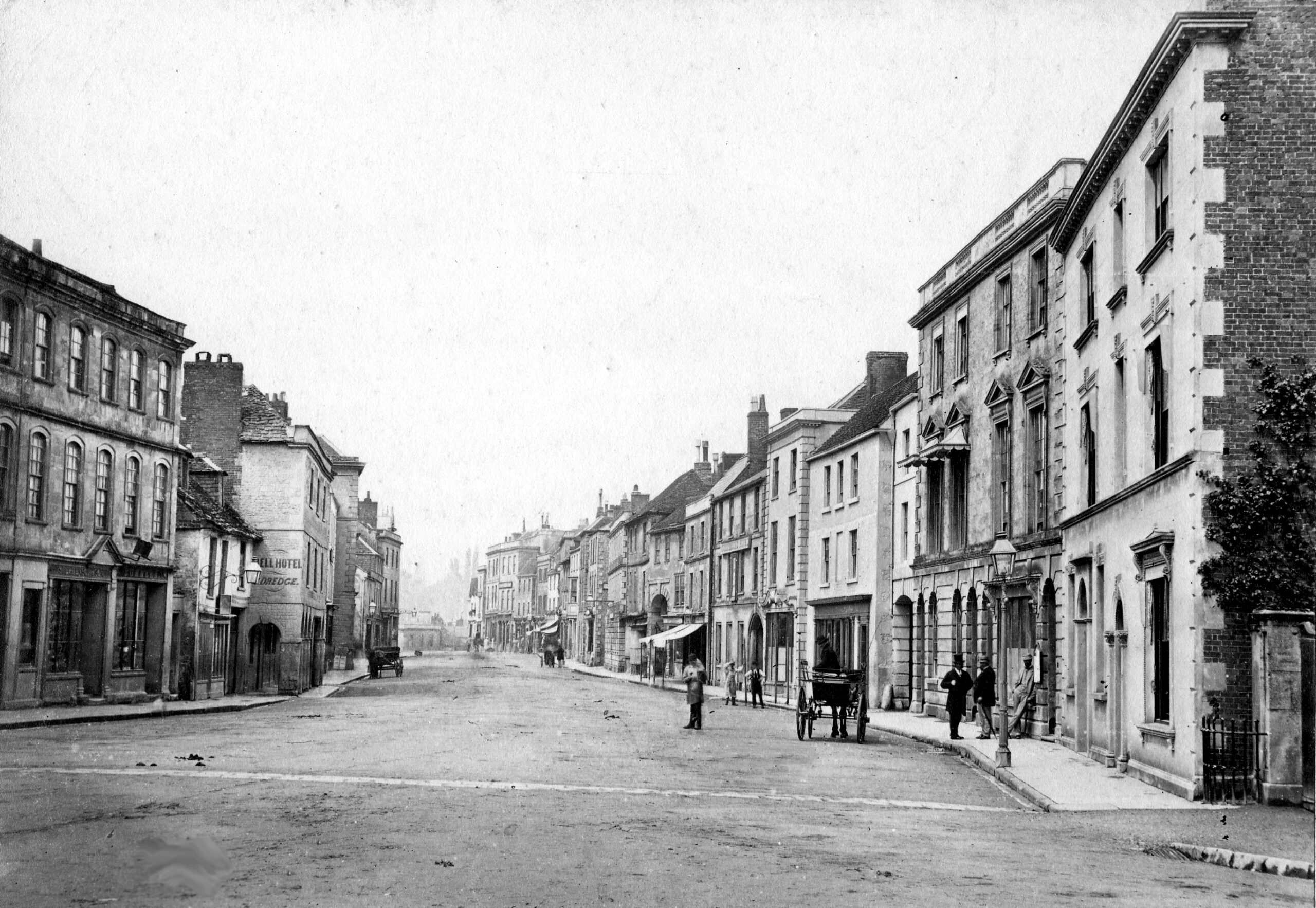
This is a most remarkable photograph. Not only is the Bell not yet the Old Bell, but the Lloyds Bank building has not yet been built.
The date stone on what was until recently, Lloyds Bank, gives the topping out date of 1873, so we can date this photograph sometime around 1871. In 1871, taking a photograph was not a matter of pointing a camera or a mobile phone at a subject and pressing a button. It really was a lot more difficult.
Mr. Smith, who took this photograph, had a studio and dark room in East Street. He probably set up his camera in a suitable position, ensured that a photograph would be suitably well focused, then left an assistant to stand guard over the camera while he went back to his dark room to prepare a glass plate. He prepared the light-sensitive chemical mix and spread this mixture over the surface of the glass plate. He now had about 15 or 20 minutes to take the photograph and to start to develop it. The glass plate with the light-sensitive materials would have been quite useless after about 25 minutes. Yes, this is a remarkable photograph.
The rather tumble-down building beside the Bell was part of the Bell property. The shop was a butcher’s shop at about this time and the railway parcels office was also located in this building.
In the foreground you will notice a light strip across the road. This is a pedestrian crossing. The roads were not hard surfaced in those days and in wet weather especially, the surface could become very dirty. It could also be very dusty in dry weather. There was normally a child or an old woman close by the cobbled pedestrian crossing, with a broom. The odd penny or halfpenny that they earned for cleaning the way for the kind gentleman or the fine lady, was an important part of the family income. There was, of course, another problem that could befall the crossing. The exhaust from horse-drawn traffic does not float away on the breeze, as you can see in the photo.
A pedestrian crossing was one of the only places where you were allowed to clear these droppings. You could not rush out with a dustpan and brush to collect this useful manure to put on your garden. The authorities sold this right, probably on an annual basis, to the highest bidder.
Pictured: the Market Place in 1871
Send us your news!
Help us keep your community connected and informed.
Do you have an interesting story you would like to share? Have you seen something you feel needs more attention? Get in touch with a reporter today!
✉️ Click here to get in touch with a reporterSupport Local Journalism
Help us keep your community connected and informed.
Local news is under pressure more than ever. For just £5 a month, you can support independent reporting that shares local stories, investigates the issues that affect you, and keeps residents up to date.
Choose a monthly subscription or a one-off donation to support independent journalism in Warminster.