If we look at a map of Warminster town, it is clear that Market Place is much wider than East Street.
The pavement on the South side (Old Bell side) runs without serious interruption in a straight line from Market Place into East Street, but on the North side the pavement has to turn two right angles to pick up East Street, and this produces a corner.
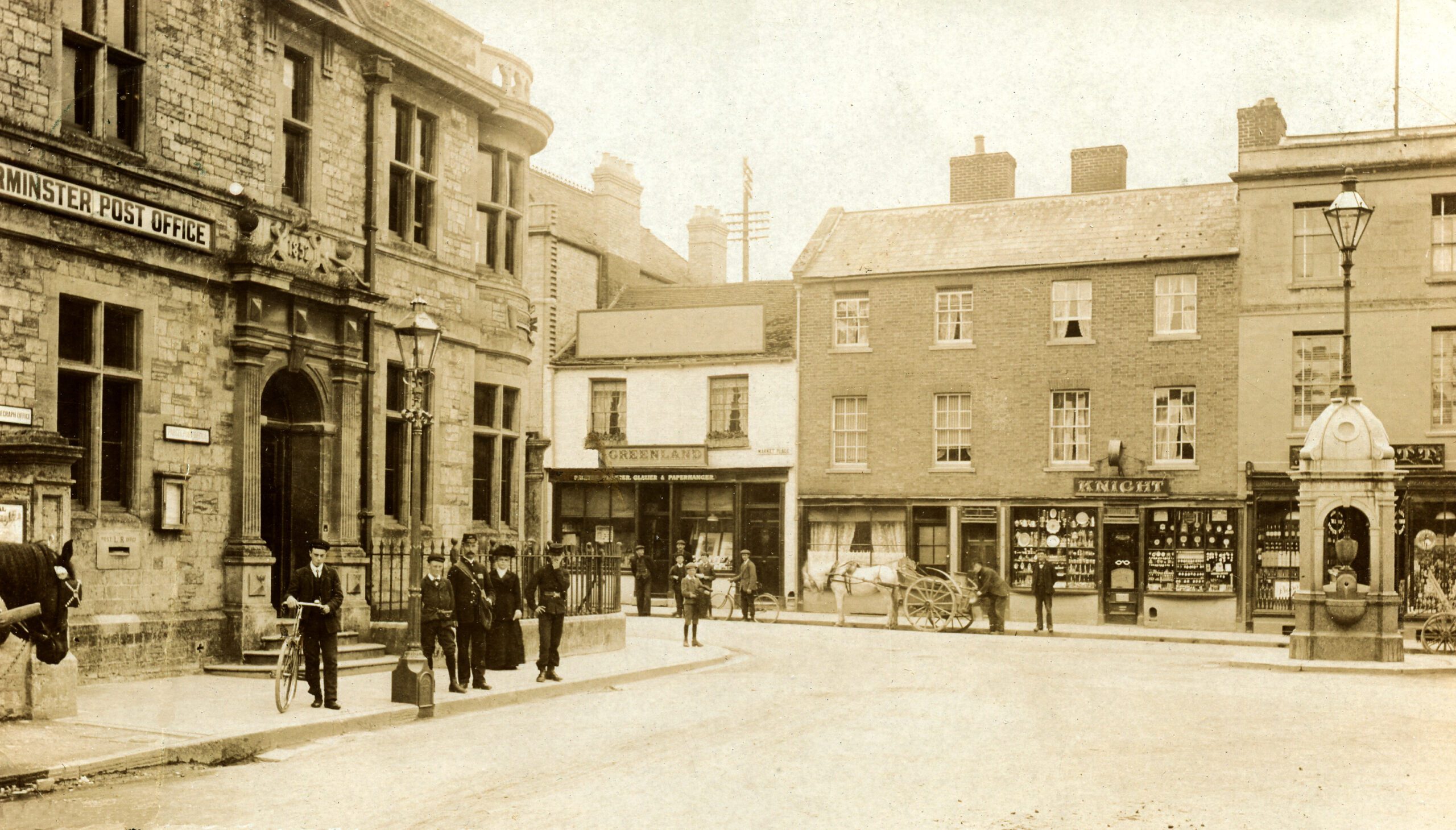
For many years the Hatchet Inn stood on this corner between East Street and Market Place, and the area was known as Hatchet Corner. The Hatchet burned down sometime before 1740, but although the Hatchet was replaced by three houses, the area was still referred to as Hatchet Corner. The picture shows the area in about 1909, shortly before the First World War. Making way for Station Road had involved demolishing the buildings around Hatchet Corner. The corner itself, with the inn standing on it, would been almost exactly where the drinking fountain is standing in the picture.
The drinking fountain in the picture is now in the Town Park in Weymouth Street. It was installed at the Station Road/Market Place junction, by Frank Morgan, in memory of his wife Catherine, who died in 1891. At the time of its installation, there was already a gas light standing in this area and the fountain was erected close beside this lamp. The lamp was a very efficient lamp, giving much a better light than the other lamps in the town, but it was a gas lamp, and progressive towns were beginning to consider the new electric lights for street lighting. Warminster UDC decided that electric street lighting should be investigated.
The Station Saw Mills, a company run by Mark Hill and situated in the area off Imber Road, behind the present Lyons Sea Food company, ran its machinery by electricity. Abner Hill, the owner’s son, had trained as an installer of electrical equipment and he looked after the power generator and the wiring at the saw mill. The council approached Abner for his views on electricity for street lighting. As you might expect, Abner was enthusiastic and the Council decided to invest in one lamp to see whether it would suit this town.
Frank Morgan said that the protecting glass cover of the lamp should be designed by the designer of the fountain. This caused a slight delay in delivery, but on 2nd February 1894, the lamp was delivered and Abner was asked to install it. When Abner saw the design of the cover he was appalled. “That is no good!”, he said. There were large sections of the cover that were metal framing and panelling, and he said that these areas would cause large areas of shadow on the street.
Abner was put in his place. The cover was designed by a highly respected designer, Abner was a mere electrical installation engineer, so Abner was instructed to set up the new light.
To feed power to the new lamp, Abner ran a cable from the generator at the wood yard. By 6th February, a suitable temporary connection could be made, and a trial run was set for that evening. Proper switches were not yet installed, so the arrangement was that, when everything was set and ready, Abner would blow on a loud horn and a switch would be thrown at the wood yard.
With council members present and a lot of activity, a large crowd had gathered. Abner blew on the horn, and the street was bathed in the new electric light for the first time. It was impressive, but there were large areas of darkness caused by the design of the cover. The Council had to accept that Abner had been right and that the cover was not satisfactory. Frank Morgan, who had commissioned the design said that he would pay the costs of the unsatisfactory cover because he had been the main person to override Abner’s objections.
A temporary opal globe was obtained, Abner continued with a full installation and the light was switched on, with due ceremony, on 12th February 1894. The Opal cover did not give the desired brilliant white light, but it was soon replaced by something more satisfactory. The plan was then to move the powerful Sugg gas lamp, that had previously been beside the Morgan drinking fountain, to the horse trough at the other end of Market Place. The council could then decide how they should proceed. Should they lay cables and install electric lighting from the fountain to the trough, or from the fountain to the Obelisk at the end of Silver Street?