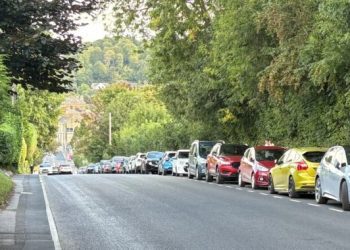
There is interest in all of Warminster’s old streets and roads, but George Street must be a special case.
If your Lord of the Manor decides that he wishes to establish a market town, then it will be necessary to be able to get to this new town. Warminster was little more than Silver Street and Church Street in the 1200s and the new market was to be established in Market Place, so George Street became necessary.
Obviously, it wasn’t called George Street, it was simply the way to get from Silver Street to the new market. Then, as the market began to attract traders from nearby places, those coming from Corsley and those from the Deverills would also travel along this new way. People like to build houses beside roads so, as time progressed and the market developed, houses were built along both sides of this way.
The market was a successful venture, and more traffic used the road. This was an opportunity for anybody so minded to set up a small business in his house. Travellers can get thirsty, so why not brew ale? ‘George Street’ later had a modest pub and some shops.
More traders came to Warminster market. They came with ever heavier loads in larger carts, and they were putting serious pressure on ‘George Street’. The problem had to be solved, and the solution was a by-pass. This was a simple by-passing of the street.
The folks on the north side of the road lost their back gardens and a larger road was constructed. Traffic along the original way was prevented by putting chains across both ends of the old road. And the nameless old way became Chain Street.
As time passed, even the new arrangement had problems. The houses without back gardens were not very desirable and they may not have been maintained very well, so the decision was made to demolish this row of houses. Records show that by 1801, half of these places had been removed.
The plan was to clear the area by the time that the next Turnpike Act was ready for Royal Assent in 1815, but one occupier, Widow Leate, refused to give up her home. Widow Leate is named in the Turnpike Act. It was obviously necessary to adapt a legal document so that she could be forced to give up her home.
Now we were able to build a new street. The land north of the street was Longleat’s property. Longleat leased the stretch between Portway and the Castle Inn to developers and it was probably Longleat who specified that the development should be a terrace of houses in the style that was in vogue at the time. We know this style today as Georgian.
Henry Wansey built three houses, Philip Nowell four, Bernard Giles three, Hugh Holman and John Hopkins one each and Noah Carpenter built a home for himself with offices and a malthouse.
A Georgian terrace is a row of houses built to the same style, and at first glance, the George Street terrace appears to be a row of identical houses which have now all been converted to shops, but on closer inspection you can see differences in the buildings of the different developers.
All the developers, except Mr Wansey, followed the rules and all their houses line up perfectly. Mr Wansey would seem to have built two of his houses, leaving one plot to be built on later, but Wansey’s first houses do not line up with the rest of the terrace and that has made the building between Wansey and Nowell a rather uncomfortable fit.
There are now only 12 houses in this terrace. Imber Court sits on the plot of the Castle Inn and on Mr Carpenter’s house, offices and malthouse.
By the way, as you may know from the Georgian city of Bath, the front of a terrace can look like a row of peas in a pod. Look at the back of the terrace, it’s a different story.