A photoraph, captured in the brief period of time that it takes the camera shutter open and close, is a time capsule.
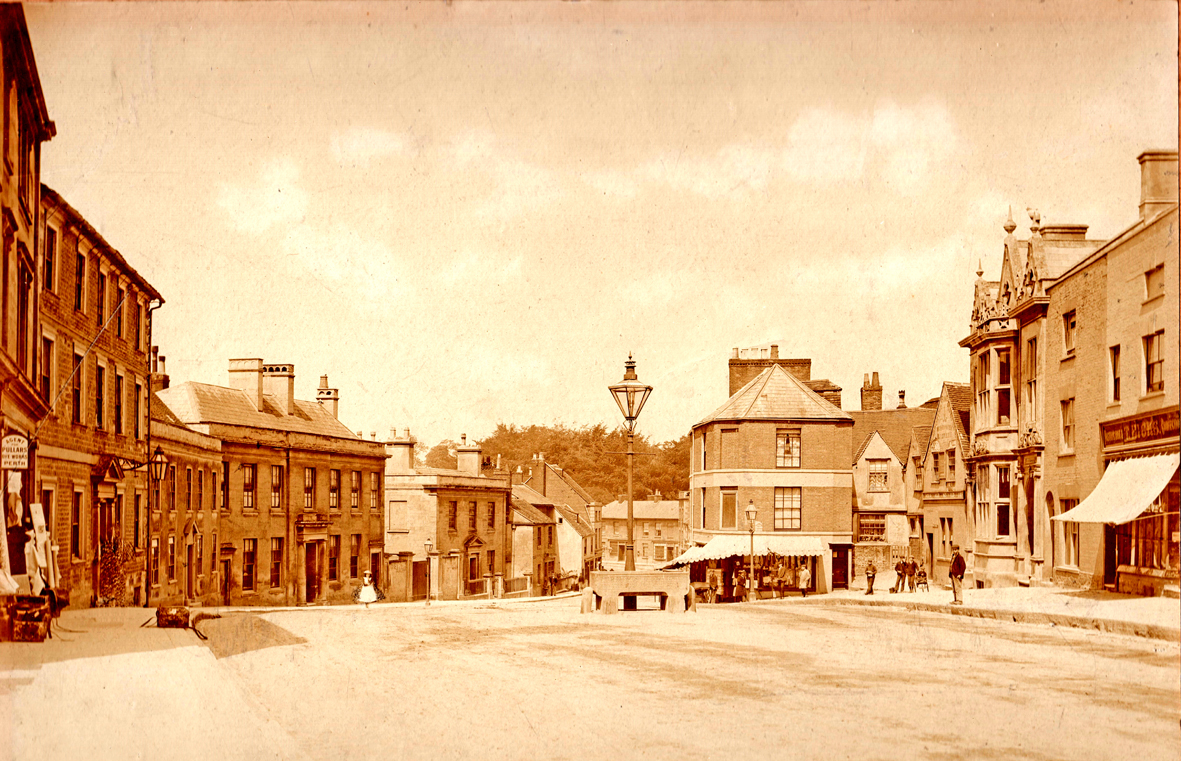
This photograph was taken by Fred Futcher, whose shop and studio were at Café Journal in the High Street, and it is so full of interest that a short article can only point out a few of the interesting features.
It was taken some time in the 1890s. The Ship Inn is still in reasonably good repair and was probably still in business. It still had its license, because Mr Hicks, the baker whose shop is at extreme right, was hoping to get the license transferred to him when the Ship would be demolished to open the way for The Close.
No.3 High Street, the building across the road, demolished very recently, seems to be thriving as a draper’s shop. John Day, the shopkeeper, has close competition, because there is another draper, Mr Coxall, across the road in what is now a delicatessen. Both shops are offering cleaning and dying, but this service is not done on the premises. John uses Pullars of Perth, Mr Coxall uses Mortimers of Plymouth. It was the railway that had made it possible for Pullar and Mortimer to offer their services nationwide.
The most striking feature of the photograph is the horse trough and the large gas lamp. On the side of the horse trough is a quote from the Bible, Book of Proverbs: “A righteous man regardeth the life of his beast”. A fine horse trough and a fine lamp, but both could be troublesome.
The prevailing wind from the west, would sometimes funnel up the High Street and blow the lamp out. Occasionally, the trough would overflow, and water would run down High Street. Normally, this would be little more than a nuisance, but when the overflow froze in the winter, it could be much more of a problem.
Going back to the left side of the picture, there is a young lady in a white dress and a white hat. She is standing in front of a very fine house. Behind this house were extensive pleasure grounds, so the owners of this house were people of some standing. When Woolworths came to Warminster, they purchased this building and they obtained planning permission convert its use to one of their stores. The planning permit was granted on the condition that the façade and some features of the building, would be preserved. Woolworths sent in their surveyor, and he declared that these conditions could not be met and that the building would have to be pulled down. It must have been important to have Woolworths in town, because the building was pulled down and replaced with what is now Sports Direct.
Moving further down, you may notice that The Factory Shop had a front garden and that Domino’s Pizza shop was a much lower building than it is today.
And just what the strange wheeled conveyance outside the Ship Inn may be is a puzzle. An invalid carriage, perhaps.